Under the Influence
How Advertising Came to Masquerade as Criticism

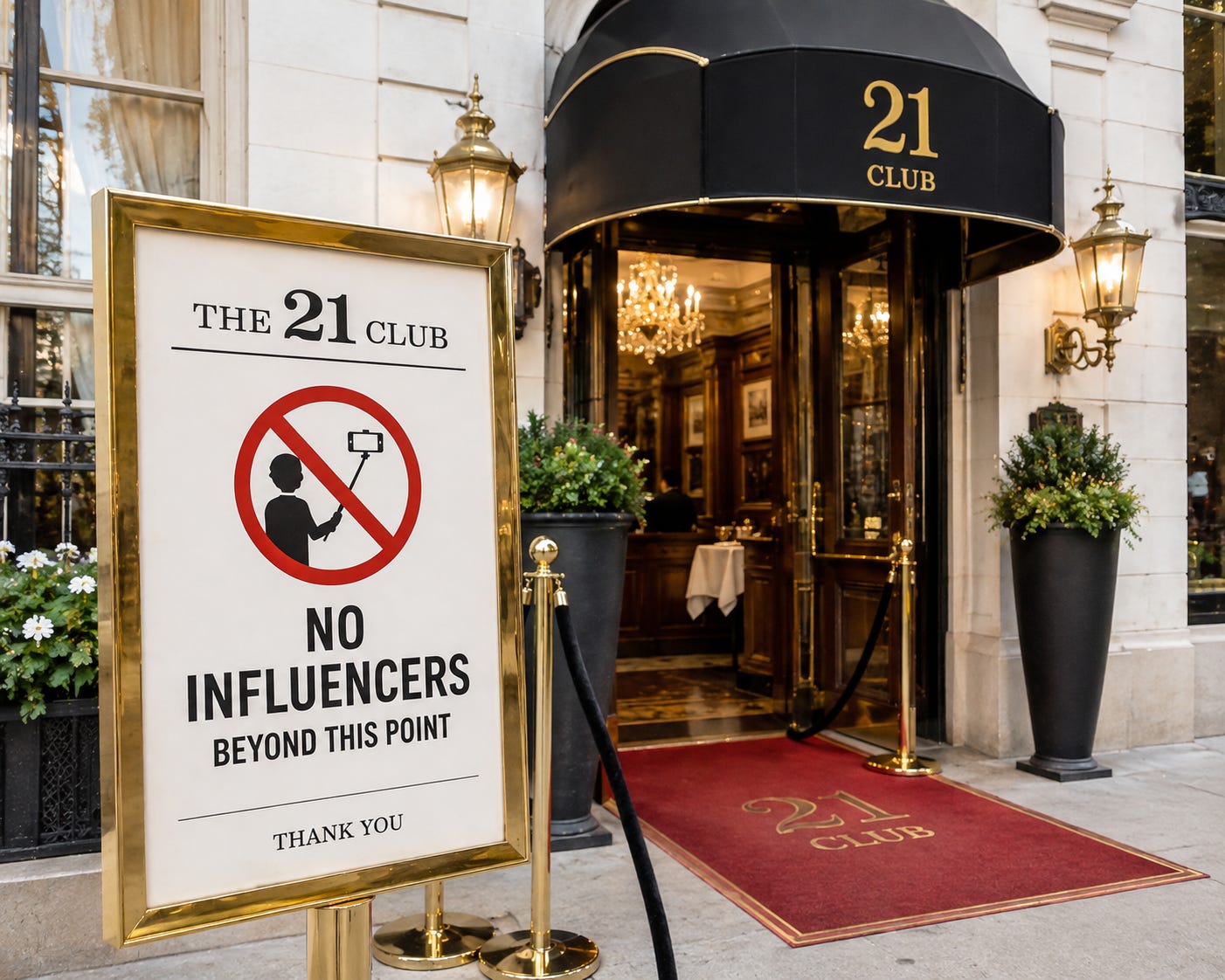
I’ve noticed a recent trend on Instagram and Facebook (the only social media in which I participate) among people who post about restaurants. It’s a popularly supported reaction to the invasion of perceived “Influencers”. Signs posted at the entrance of restaurants proclaiming the unwelcome status of these increasingly vilified cogs-in-the-publicity-machine appear in these posts followed by accolades of support thereof. Whether the images were AI-generated is beside the point. They imply an “anti-Influencer movement” which is no more than a leitmotif in the endless opera performed by those social media denizens who love to kvetch and diss.
There is no organized movement, to my knowledge. The problem lies, as I have previously stated, within the current global restaurant culture, formed and adhered to by chefs and patrons eager to conform to, and sheepishly follow, trends and the people who proffer them. The idea of a restaurant formulated to a supposed contemporary, fashionable style is what’s at issue. The problem is not influencers. The problem is the restaurant culture that produced them.
I have written before about what I see as the current restaurant aesthetic: menus that insist upon multi-element dishes built from awkward combinations of formerly distinct ingredients; local foods artificially elevated simply because they were once considered humble; forced fusions intended to wow but which instead diminish—sometimes even insult—the cuisines being fused. Presentation for the camera. Theatrical service. Plates designed to be photographed before they’re eaten.
Enter the influencer. An influencer is not necessarily someone knowledgeable about food. He or she is someone good at self-promotion, someone with an audience valuable enough that restaurants will gladly trade dinner for publicity. Their job is not criticism. Their job is content. There’s nothing new here. Famous people have been plugging products to us forever and we believed them because we wanted a piece of the life they represented. Did Dinah Shore actually “see the U.S.A. in her Chevrolet”? Did Annette Funicello spend her afternoons with her fingers buried in a jar of Skippy Peanut Butter? Does @foodie_whatever really adore Bistrot X?
Cynical comedian W.C. Fields famously advised, “Never give a sucker an even break.” The public has always believed what it wishes to believe.
The difference today is not the existence of advertising. It is that advertising increasingly masquerades as criticism.
I have been fascinated by other people’s food for as long as I can remember. At six years old, studying the menu at the old Greenwich Village Spanish restaurant Sevilla, I astonished my parents by ordering almejas en salsa verde. At 10, on my first trip outside the continental United States, to Puerto Rico, the heady aroma of sopa de ajo—an egg bathing serenely in its garlicky broth—lodged itself permanently in my memory. I have asked foreigners what they eat for as long as I remember. That fascination eventually became a career. I have now spent nearly twenty years writing professionally about food, though I came to it later in life. Long before Instagram, before reels, before hashtags. I confess to being opinionated. I dislike trendiness, falsity, pretension. And I don’t see much need to “reinvent” dishes that have survived perfectly well for centuries. Why produce “a new take on...” when the old take is magnificent? Have we really exhausted the regional cuisines of India, France, Japan or Mexico to such an extent that we must fuse them together simply to manufacture novelty?
The truly sad thing is not the rise of influencers but the disappearance of the critic. The restaurant critic—already an endangered species and never much of a presence in the heavily censored press of Latin America—is being replaced not by another generation of critics but by paid entertainers. Gone are the Pete Wellses, the Ruth Reichls, the Jonathan Golds. Even Anthony Bourdain, whose television persona could be gloriously obnoxious while his writing remained remarkably perceptive. These independent voices are becoming rarer. Instead we are encouraged to consume an endless stream of smiling recommendations in which everything is “amazing,” every cocktail is “insane,” every taco “slaps,” every chef is a “genius,” and every meal deserves twelve heart emojis. Perhaps it does; more often, I suspect, it doesn’t.
Increasingly, restaurants are becoming stages upon which chefs, diners, influencers and publicists all perform for one another. To eat at the fashionable address is to join the club. The ‘mean cheerleaders’ from high school have finally invited you to sit at their table—provided, of course, you remember to follow and tag them.
From time to time I receive invitations offering a complimentary meal—sometimes with a budget, two drinks included—in exchange for posts, stories and reels. I always decline. I explain that I’m a writer, not an influencer. Not because I believe I’m morally superior, but because I value my independence. If I recommend a restaurant, I want readers to know that recommendation wasn’t negotiated in advance. Occasionally that polite refusal results in a different invitation—with no strings attached—which I am perfectly happy to accept.
A restaurant critic isn’t there to cheerlead, to destroy, or to accumulate invitations. We are there to observe, to compare, to remember, and to describe honestly what we find. To add context, subjective opinions. Sometimes we’ll offend. Good. Better an opinion worth arguing about than another sponsored smile beneath a photograph of a perfectly lit risotto.
I'd draw the line in a slightly different place: between not publishing a bad meal and being paid not to.
I only write about places I'd recommend, which by your description puts me somewhere near the smiling crowd. The part I care about is that nothing gets arranged in advance. No comp, no brief, no tag required. I'm not a critic and don't pretend to be, but I think advertising begins where the free meal does, wherever the verdict lands.
No argument on the disappearance though. Somebody has to be able to say a thing is bad, and fewer and fewer people are paid to.